Congratulations to Tim and the team for a very fine 1914 Little Wars game in brave little Belgium - always a FLW favourite!
https://megablitzandmore.blogspot.com/2025/12/the-last-redoubt-belgium-1914-part-1.html

Congratulations to Tim and the team for a very fine 1914 Little Wars game in brave little Belgium - always a FLW favourite!
https://megablitzandmore.blogspot.com/2025/12/the-last-redoubt-belgium-1914-part-1.html

On the other blog, the aim is to develop a FT Jane type of naval campaign set in 190?.
Here, the main effort will be in an indoor Kriegspiel set in the FLW era and using Moltke's practical schemes for the inspiration.
It is also an opportunity to share some of the photos that didn't make it into Garden Campaigns.

 |

This year's garden wargame activity has been concentrated on garden sieges on the sister Blog;
https://shandyandvauban.blogspot.com/
The summer campaign was based on the Victorian siege exercises in Chatham in the 1860's. The 'winter quarters' activity is a more Wellsian naval campaign set in North America 190? ...
I hope that you have all enjoyed a happy summer of garden wargaming.

I was delighted to watch this excellent After Action Report from Bob C. It is truly the spirit of Little wars and Funny Little Wars, and a Wellsian original. Bravo to all our friends at WD!

https://wargamingmiscellany.blogspot.com/2025/07/a-new-youtube-video-its-fair-kop.html
And here, another incarnation of Backsight Forethought - he of Duffer's Drift fame.

On a recent visit to Sweden, I had the pleasure of visiting the castle of Roserberg.
'At Rosersberg Palace, north of Stockholm, time has stood still. The rooms remain almost untouched from the 1795-1860 period, with well-preserved interiors and collections. King Karl XIV Johan and Queen Desideria were the last members of royalty to live here'
It is the most remarkable time capsule - and had some delightful surprises.


Erik from Tradition was one of our delightful hosts.


Garden Campaigns is now available from;
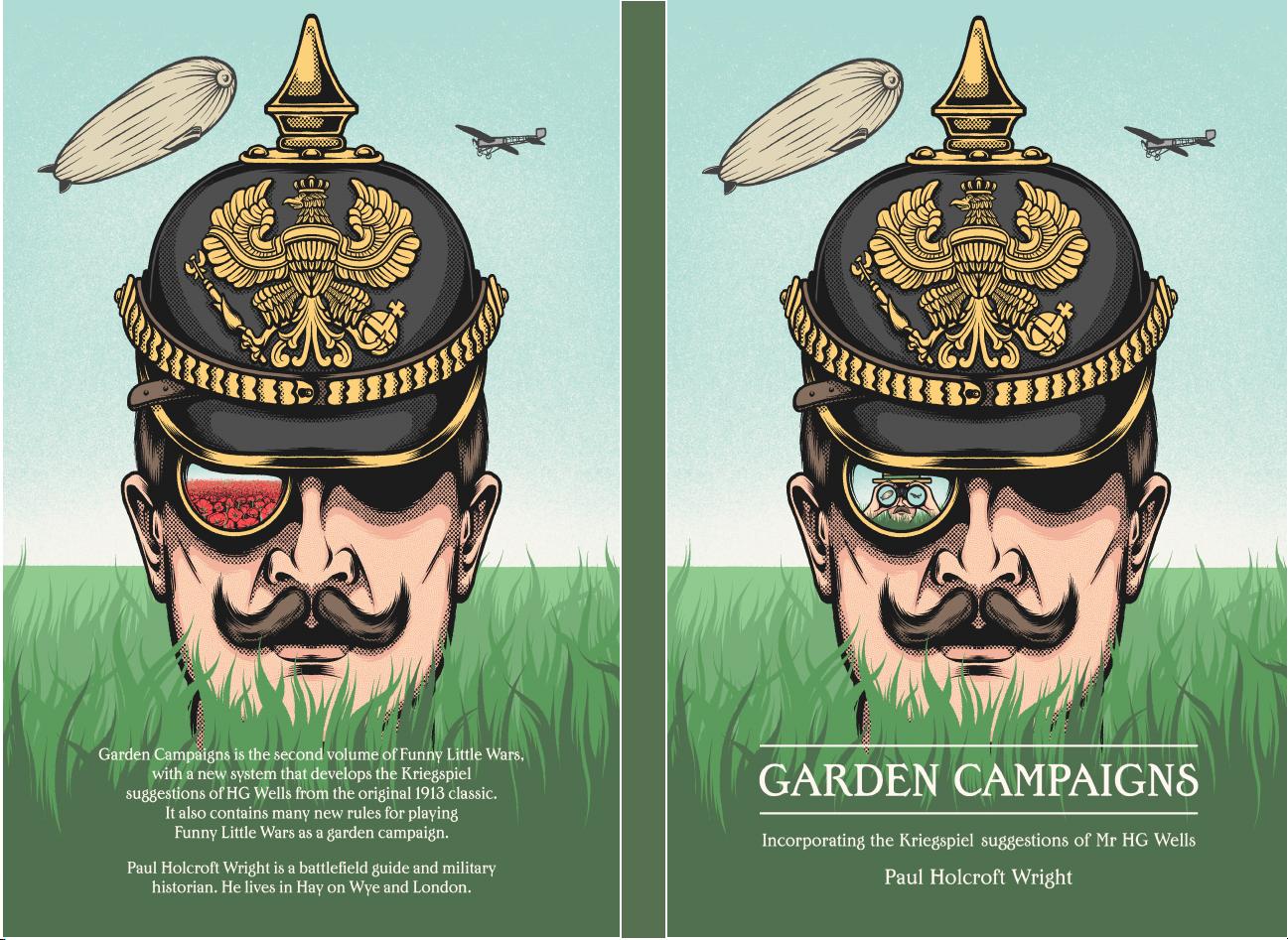
Garden Campaigns is the second volume of Funny Little Wars. It continues the story of HG Wells classic toy soldier wargames book, 'Little Wars' and provides a system for playing HG's Kriegsspiel suggestions and annotations. It also explores the extraordinary Edwardian novelist, William Le Queux and his book, 'The Invasion of 1910.' A series of campaign games is developed from this truly Wellsian, and Little Wars, 'shocker'. Zeppelins, forts and many new rules are included.

The book will also be available at Tradition, Stockholm and the Armoury of St James in London.
Things continue to move forward with the Garden Campaigns, and the proof reading is nearly 50% completed.
The new edition aims to recreate HG's amplifications at the end of Little Wars, and it is also a homage to William le Queux's 'The Invasion of 1910.' This is a remarkably Little Wars type of book!


From Divisional HQ,
Hotel Supremo (5*), Venice
Commander, there have been logistical issues…
Would you prefer the mules to bring forward:
The mountain artillery
or
The HMG company ...
Bombardment phase

The Austrian HE fell in front of COPSE A
The attack followed with the Alpini scaling the left flank and the Arditi assaulting the Table. Excellent Italian artillery fire silenced the defenders on the ridge line.
Both sides used gas, and the assault was pressed home in very limited visibility.


Before playing the floor game, the campaign was played online, with taskings and orders and aero recce;

Italian Briefing
Situation -
You are commanding a Brigade of Mountain troops - the Arditi and Alpini are rated excellent, the Infantry average.


OOB
HQ
1 x Arditi Battalion – 2 x Independent Coys
1 x Alpini Battalion – can scale the flanks
1 x Infantry Battalion
1 x Battery light artillery – 2 x light gun with mules
3 x turns of heavy artillery pre - bombardment including gas
– 4 tubes in total
1 x turn of bombardment after Zero Hour
Austrian Briefing
Situation
You are commanding a Battalion of Mountain troops, supported by a Platoon of Assault troops - all are rated excellent.

 |
| Italian start line |
HQ – currently at HILL 103
1 x Battalion – currently 1 x Coy at the TABLE, and 1 x Coy
on the ridge line HILL 103 – HILL 130
1 x Assault Platoon – in Reserve
1 x MG Coy – 2 x mg – in bunkers below at HILL 103 and HILL
130 - connecting with the first and
second Company.
OP – at HILL 130 with comms to the Artillery and all
positions
1 x turn of bombardment after Zero Hour
3. Please provide orders for the Battalion, and your own initial position and future intent.
Winter Quarters in FLW land is filled with the Campaign books and other editing questions, but there is room for a winter game or two. In 2020 we played a game set in the 'immobile' front; the Alps in 1916/1917. And the hope is to return again, in the coming weeks.

The original game was a mini campaign, and TG and JW faced off (virtually) as the Italian and Austro Hungarian armies. Like many of our 'Big War' (HG's description of the Great War) it was palyed in three phases;
Winter, 1917, and the stalemate continues on the immobile
front. The Italian army is expected to
launch an offensive to capture the SOFA mountain - peaks 130, 103 and 113, a fortified mountain peak
that would allow the Italian army to have an undisputed field of fire towards
the Austrian road network beyond the mountain below.
The Italians have the men, the Austro-Hungarians the summits.

The Austrian front line
The Front runs from HILL 130 – across the valley to the feature
called ‘the Table/La Tavola/Der Tisch’ and runs up to HILL 113 at the south of
the perimeter. HILL 103 is on the
opposite side of the valley to HILL 13O, and is the central high point of the
mountain.
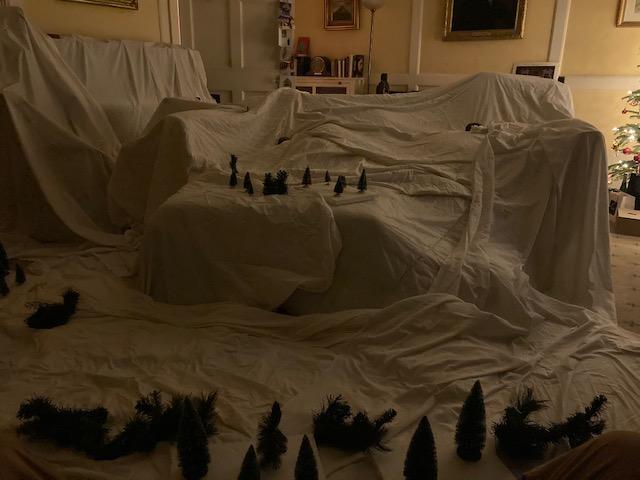
Please note HILL 130 &c are 130cm above floor level. SOFA montain is a sofa. The Table is so called because it is a table. The tree line stops here.

View from 130 
View from 103
The Italian Front Line
The Italian front line runs along the tree line A – B – C.
 |
| View from 'B' |
The briefing will follow ...
I was delighetd to find this piece about the 1911 Railway strike:
https://www.world-of-railways.co.uk/news/modelling-the-first-rail-strike-of-1911/


